Spain Spends More on New Tracks Than on Fixing Old Ones
Engineers point to maintenance spending figures after two collisions this year on the same Madrid-Seville line.
By Daniel Rogers ·
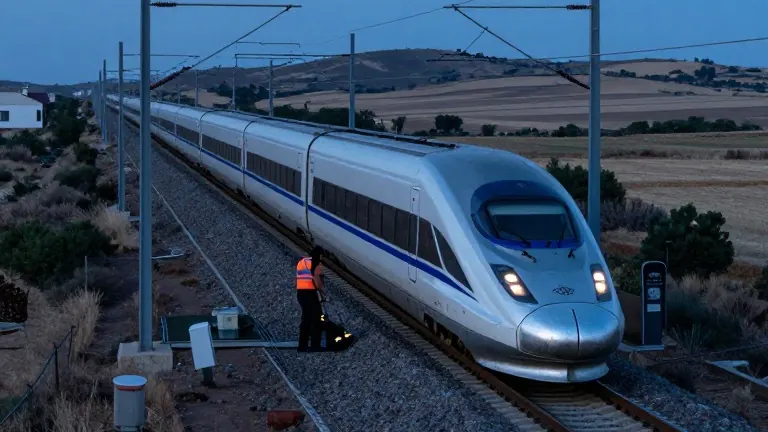
Two trains collided near Urda, a town close to Toledo, on October 28, killing at least 69 people. It was the second such crash this year on the Madrid-Seville line, where two other trains struck each other near Adamuz in January, killing 46 people. In 2013, a high-speed train ran at 200km/h through a curve meant for 80km/h at Angrois, near Santiago de Compostela, killing 80 people. Those three accidents account for 195 deaths on Spanish rails in about 13 years.
The pattern has shifted the argument from any single cause to how Spain divides its rail money. European Commission figures show Spain averaged about $1.67bn a year on high-speed lines from 2018 to 2022, more than peers with comparable networks. Of that, 16 percent went to maintenance and repairs. Italy, Germany and France put 33 to 39 percent of their budgets into upkeep despite running networks smaller than Spain's 4,000km.
Jose Maria Goicolea, spokesman for the Spanish Association of Civil Engineers, said the network has outgrown its funding formula. "In 1982, when there was the first line, it was a very small network. Now it is much bigger with much more usage. It is a whole new ball game now. The emphasis cannot be only on building new lines but doing more maintenance," he said. Ramiro Aupin Lopera, who lectures on infrastructure at the University Politecnica de Catalunya, called the post-2011 decline in maintenance spending "ridiculous" and tied it to rising ridership.
Ridership did rise. About 40 million people rode Spain's high-speed trains in 2024, close to double the 2019 figure. The first half of 2026 brought roughly 25 million trips, down 14 percent from a year earlier.
Investigators have assigned different causes to the three crashes. A broken rail sent a train off the line at Adamuz in January. Goicolea said the Urda collision points to human error alongside a control system failure. The Madrid-Seville line runs on an LZB system built in Germany in the 1970s and now being phased out. Goicolea recommended closing the line while LZB is retired: "It was only partly responsible for Wednesday's crash. It failed. But the other reason was human error, it seems." Helen Venezuela, then director of Ouigo Espana, told Cadena Ser last year that operating on LZB "is like watching Netflix in black and white. We are Netflix and the system is still in black and white."
Diego Martin of SEMAF, the train drivers' union, rejected the push to pin blame on staff. "Blame does not prevent accidents; identifying and determining the causes does," he said. Cristobal Gonalez, who was in the front carriage at Angrois and still lives with post-traumatic stress, put it plainly: "They will keep happening if we do not act." Spain's high-speed network has carried trains since the first line opened in 1982.
Source: Al Jazeera