Scientists Identify Turkey-Sized Dinosaur Adapted for Fruit Diet
New species Infernogallus jamesi features unique chewing muscles similar to parrots, marking the first known dinosaur specialized for eating fruit.
By Rebecca Kaminski ·
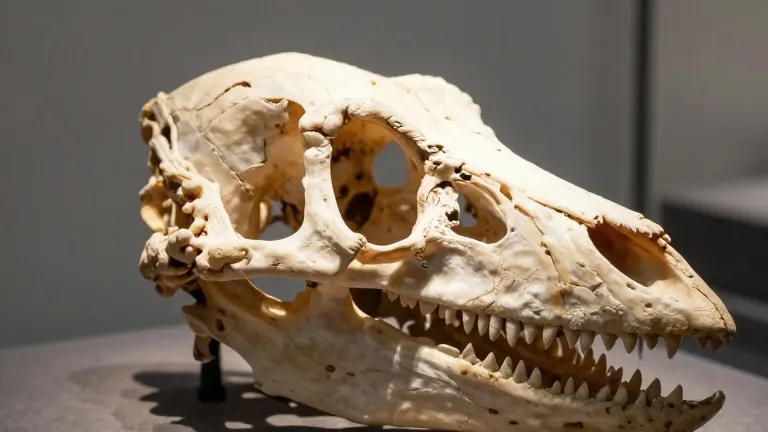
Paleontologists have identified the first dinosaur species specifically adapted to eat fruit.
The discovery centers on Infernogallus jamesi, a small, toothless, feathered biped from the Cretaceous period. The animal lived between 145 and 66 million years ago in what is now the western United States. Fossils of the species were found in the Hell Creek Formation, a site spanning Montana, North Dakota, South Dakota, and Wyoming. The remains include a nearly complete articulated skull and partial skeleton currently displayed at the Royal Ontario Museum.
Greg Funston, an assistant professor in the Department of Anatomical Sciences at Stony Brook University, led the international team. He is the corresponding author of the paper published in Nature Communications. Funston noted that while dinosaurs filled many ecological roles, a dedicated fruit-eater was unexpected. The team analyzed the chewing mechanics of the skull to determine its diet.
Infernogallus jamesi was roughly the size of a turkey and weighed approximately 12 kilograms. It belonged to the caenagnathid group, which evolved from meat-eating ancestors. The skull anatomy reveals a specialized mechanism for mashing stone fruits. The palatal bones arched downward into the mouth, changing the orientation of the chewing muscles. This structure allowed the beak to slide back and forth during chewing, a motion similar to human jaw movement rather than the vertical bite seen in T. rex.
The muscle arrangement is rare in the animal kingdom. Researchers found parallels only in complex mammalian chewing and in specific fruit-eating birds like the Vulturine Parrot. Thomas Dudgeon, a postdoctoral research fellow at the Royal Ontario Museum and co-author of the study, described the anatomy as bizarre among dinosaurs. He stated that the team quickly realized they were dealing with a unique biological adaptation for processing soft foods in the mouth.
The finding suggests a link between dinosaur diversity and the evolution of flowering plants. During the Cretaceous, flowering plants replaced cone-bearing plants as the dominant vegetation. The specialized chewing ability of Infernogallus indicates that dinosaurs may have played an unrecognized role as seed dispersers for these new plants. This challenges previous assumptions about the ecological interactions of the era.
David Evans, Chief Curator of Natural History at the Royal Ontario Museum and senior author on the paper, emphasized the rarity of complete remains for such small dinosaurs. He noted that the strange skull provides new insights into feeding specialization. The discovery confirms that the world of T. rex included diverse species with complex dietary niches previously unknown to science.
Source: Stony Brook University News