Frankfurt Protests Turn Violent
Hooded rioters looted stores in the German financial hub after tens of thousands marched nationwide on Saturday.
By Daniel Rogers ·
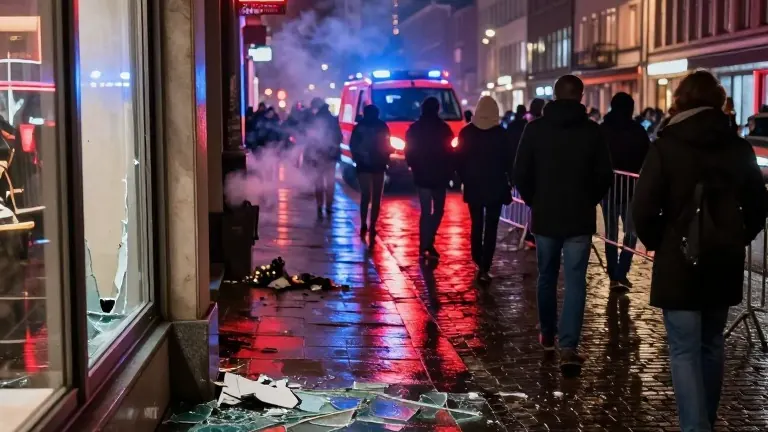
Hooded demonstrators smashed windows and threw Molotov cocktails at emergency vehicles in Frankfurt late Saturday night. The violence broke out after tens of thousands of people marched through Germany’s major cities to demand lower living costs and better schools. Police in the financial center worked to contain the unrest as the protests, which coincided with Halloween, turned chaotic.
Organizers of the campaign, known as Gen Z regelt, planned demonstrations in 34 cities including Berlin, Munich, and Frankfurt. The group opposes compulsory military service and seeks increased investment in education. Many young Germans are facing rising expenses, and the movement has drawn parallels to recent student-led protests in Serbia and France.
Turnout on Saturday fell short of the 182,000 participants organizers initially predicted. Police in Frankfurt, Munich, and Berlin counted as many as 18,000 protesters in those cities combined. This figure is roughly half of the 36,000 listed on the organizers’ website. The lower numbers suggest a gap between online planning and physical attendance.
In Frankfurt, at least two stores were looted, and several others suffered damage. A Reuters witness reported that police struggled to regain control of the streets. The city’s police department posted on social media that violent disturbances were ongoing in the city center. They urged bystanders to leave the area or stay away due to smashed windows and projectiles aimed at responders.
Lina Friedrich, a spokesperson for Gen Z regelt, spoke in Berlin on Saturday. She said the group is fighting for peace and freedom rather than war and coercion. Friedrich stated that the movement’s top priorities are better support for health and education systems. She also confirmed the group’s stance against mandatory military service and in favor of a fairer distribution of financial burdens.
German authorities described the demonstrations as largely peaceful but warned that extremist groups were trying to exploit the movement. The federal interior ministry said parts of the far-left extremist scene and groups linked to foreign movements joined the mobilization. Roman Poseck, the interior minister for the state of Hesse, said officials are watching for patterns similar to the recent unrest in France.
Poseck noted that images of looting and burning police vehicles from France are on everyone’s mind. He stated that France should not be used as a model for how the protests unfold in Germany. In Hamburg, some barricades were set on fire, indicating that tensions were not limited to Frankfurt. Businesses in several cities boarded up windows and planned early closures to protect their stock.
Along Berlin’s Kurfuerstendamm, a luxury shopping boulevard, shops took precautions against possible unrest. Steve, an 18-year-old student speaking at a rally in Munich, addressed Chancellor Friedrich Merz. He said the government has offered no response to their concerns other than continuing to make cuts. Steve promised the group would continue to exercise its right to assemble until it felt heard.
Germany’s economy has struggled to regain growth, and public services face pressure as the population ages. Questions have emerged about who is driving the Gen Z regelt campaign. The national student umbrella organization, BSK, has distanced itself from the initiative and plans a separate protest on Nov. 20. Sean Baker, a student at the Technical University of Berlin, joined the Saturday marches to highlight the poor condition of campus buildings. He described the rooms as looking like an abandoned building.
The protests mark the latest wave of Gen Z-led activism across Europe. In Serbia, student activism helped unseat the country’s longtime leader. In France, recent protests have descended into rioting and looting. German authorities are monitoring the situation closely as they prepare for potential further demonstrations in the coming weeks.
Source: New York Post