China Opens 1 Million Probes Ahead of Xi's Fourth Term
Disciplinary authorities investigated over one million individuals last year, intensifying the anti-corruption drive as the Communist Party prepares for a pivotal leadership gathering.
By Fatima Popov ·
More than 1 million investigations were opened by Chinese disciplinary authorities in the previous year, a figure that includes over 100 officials at or above the ministerial or provincial level. The scale of these probes continues to expand as the Communist Party of China (CCP) gears up for a high-stakes meeting this week. This assembly will determine the party's approach to internal discipline and loyalty ahead of a leadership transition.
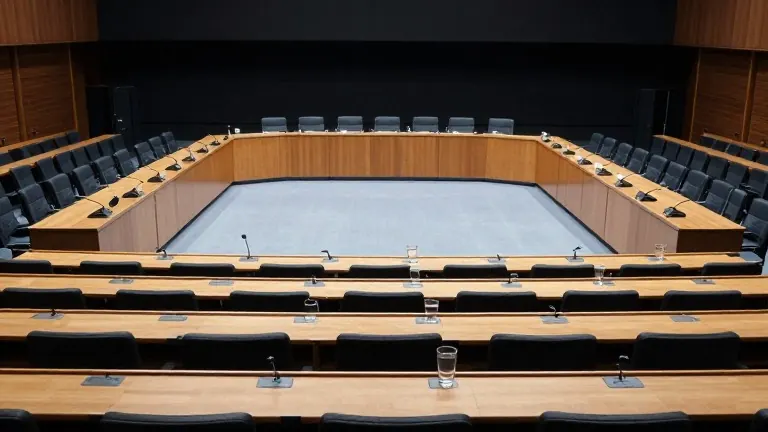
The fifth plenum, scheduled to begin on Monday, will focus on advancing the party's rigorous self-governance. State media describe the agenda as addressing major issues in internal administration, a term that serves as a proxy for discipline, loyalty, and anti-corruption measures. For political analysts observing the CCP, the apparent lack of discipline is currently the dominant concern among elite discussions. The gathering brings together more than 300 members of the Central Committee, the most senior tier of the party hierarchy.
Kerry Brown, director of the Lau China Institute at King’s College London, notes that in Xi Jinping’s worldview, political loyalty and corruption are often inseparable. Brown explains that if an official is corrupt, they are not politically loyal, and if they are loyal, they are not corrupt. He adds that corruption in the CCP system extends beyond material gains to include spiritual corruption, which encompasses political disloyalty. This conceptual blend allows leadership to use anti-graft measures as a tool for enforcing unity.
Neil Thomas, a senior fellow at the Asia Society thinktank, argues that the enduring nature of the anti-graft drive reflects the structural reality of an authoritarian system governing 1.4 billion people. Thomas states that while Xi has made the party less corrupt and strengthened his control, tougher punishment alone cannot resolve the tendency of officials to prioritize personal interests. The strategy involves keeping discipline tight, making anti-corruption a permanent method of governance with no declared endpoint.
The timing of the plenum is strategic, as it is likely the last substantive meeting before next year’s 21st Party Congress. At that congress, a new Central Committee will be chosen, and Xi is expected to secure a fourth term as head of the CCP. Eliminating individuals who pose a risk to his authority or the party’s credibility is a key priority. Xi has previously warned that the party could lose its ruling status and be eliminated by history if it failed to maintain internal order, a threat he described as no exaggeration.
Recent high-profile investigations have targeted senior party and military leaders, signaling the reach of the crackdown. In January, Zhang Youxia, China’s top general, was placed under investigation and subsequently expelled from the party. He had already been removed from the Central Military Commission (CMC), the military’s top ruling body. The purges have reduced the CMC, which normally has seven members, to just two: Xi and Zhang Shengmin, the commission’s head of discipline.
Other recent targets include Ma Xingrui, the former party secretary for Xinjiang, and Huang Qifan, the former mayor of Chongqing. Huang had previously survived political scrutiny due to connections to the early 2010s scandals involving Bo Xilai, Xi’s former rival. Bo was convicted of bribery and embezzlement and is serving a life sentence, but Huang’s long-standing resilience has now been broken. These removals from the highest echelons of power indicate a sustained effort to clear potential threats before the next leadership cycle.
Analysts question whether these purges indicate regime instability, but Xi likely views them as demonstrations of authority. Brown describes corruption investigations as the most natural tool for enforcing discipline within the party. The consistent application of these measures serves to tighten the grip on the party apparatus, ensuring that loyalty remains the primary currency of political survival as Xi prepares for another term.
Source: The Guardian