Avian Cognition: Crows Match Primate Logic with Double the Speed
New research reveals that crows process visual information using the same decision-making mechanisms as monkeys, but they reach conclusions at twice the rate.
By Rebecca Kaminski ·
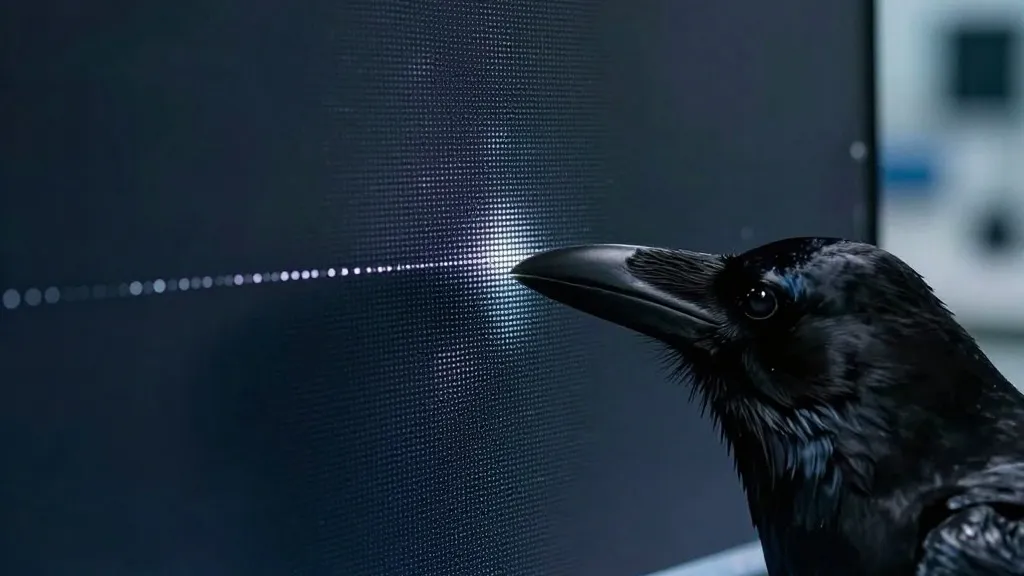
Eighty-one percent. That is the highest level of coherent movement in a cloud of dots that scientists used to test avian cognition in a new study. The figure represents the easiest end of the difficulty spectrum for the birds, yet it anchors a broader finding about how non-primate brains handle complex choices. The results suggest that crows reach decisions using the same fundamental logic as primates, but they do so at double the speed.
The study challenges long-standing assumptions about brain architecture. Much of what we know regarding decision-making comes from experiments involving monkeys. In those tests, neurons in the neocortex collect visual evidence over time. Their firing rates rise until they hit a specific threshold. Once that point is crossed, the animal commits to a choice. Birds do not have a neocortex. This structural difference left a significant gap in our understanding of how avian brains manage similar cognitive tasks.
Andreas Nieder, a neurobiologist at the University of Tübingen, described this gap as the central mystery of the research. He noted that the team needed to understand how a differently organized avian brain encodes decisions. To address this, Nieder and colleague Philipp Schmidbauer conducted experiments on two hand-raised carrion crows. They monitored the birds' brain activity while they completed a specific visual task.
The setup mirrored the standard test used for primates. The crows sat before a touch-sensitive monitor displaying white dots on a black background. A portion of these dots drifted together in one of four directions. The birds indicated their perception by pecking a target flanking the display. A correct selection earned them a mealworm. Nieder emphasized that the team wanted the conditions to be identical to the monkey version to ensure a fair comparison.
The only procedural difference involved the method of response. Monkeys indicate their decision through eye movements. The crows had to use their beaks. The researchers varied the difficulty of the task by adjusting the percentage of dots moving coherently. At the hardest end, only three percent of the dots moved together, making the direction barely distinguishable from random noise. The team also included a zero percent condition where no correct answer existed.
The data showed that the crows solved the task using the same mathematical logic as primates. This finding is significant because it indicates that a brain without a neocortex can arrive at decisions through a comparable process. The birds did not just guess; they accumulated evidence over time. Their neural activity followed the same trajectory as that seen in primate studies. The structural differences between the two groups did not prevent the emergence of this shared computational strategy.
Speed was the most striking variable in the results. The crows completed the task twice as fast as the monkeys. This efficiency suggests that the avian brain may process this type of visual information more rapidly than the primate brain. The study provides concrete evidence that different neural architectures can converge on similar solutions for complex problems. It broadens the scope of comparative neuroscience by showing that the logic of decision-making is not exclusive to mammals.
The implications for understanding animal intelligence are clear. The random-dot-motion task is a standard tool for measuring how brains integrate sensory data. By passing this test with high efficiency, crows join a list of species that demonstrate sophisticated cognitive abilities. The study does not claim that crow brains are superior to monkey brains. It simply highlights that different evolutionary paths can lead to similar functional outcomes. The work opens new avenues for exploring how other animals with non-mammalian brains handle information.
This research contributes to a growing body of work that challenges human-centric views of intelligence. By isolating the core logic of decision-making, scientists can compare species across vast evolutionary distances. The findings from the University of Tübingen team add a new layer to this conversation. They show that speed and structural simplicity can coexist with complex logical processing. As technology advances, understanding these biological models may inform how we design artificial systems that make rapid, evidence-based choices.
Source: Ars Technica