70,000 Dead: The Weight Behind Israel's Tightest Election
With polls showing a dead heat between pro- and anti-Netanyahu blocs, voters in Israel are weighing a prime minister who has held power for 19 of the last 30 years.
By Fatima Popov ·
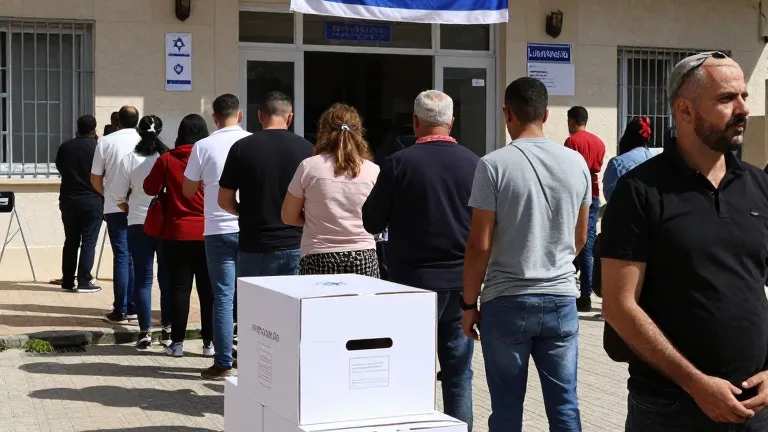
More than 70,000 Palestinians died in the Gaza war fought under Benjamin Netanyahu’s leadership. That death toll, along with his 19-year tenure as prime minister, forms the backdrop to a Knesset election where polls show the two main camps running neck and neck. Israelis cast their ballots on Tuesday in a race defined less by traditional left-right lines and more by a personal referendum on Netanyahu.
The leading challenger, Gadi Eisenkot, is a former IDF chief of staff who entered politics just four years ago. His party, Yashar, translates to direct or straight. Eisenkot advocates for US-style term limits for the prime minister, arguing that power corrupts. At a rally in Modi'in, attendees praised his plain speaking style. Noa Sadeh, 56, said she is tired of politicians who know how to talk and wants someone who will do the work.
The opposition is not a unified block but a collection of figures who once worked with Netanyahu before falling out. Naftali Bennett and Avigdor Lieberman, both from the nationalist right, join the anti-Netanyahu camp. On the far right, Yishai Fleisher of the Otzma Yehudit party argues that Netanyahu has drifted too far left. Fleisher pushed for more settlements, a ministry to manage the voluntary departure of Palestinians, and the death penalty.
Netanyahu’s campaign has focused on a binary choice between the right and Palestine. His posters place opposition leaders alongside heads of parties representing Palestinian citizens, who make up about one-fifth of the population. Pro-Netanyahu media have kept the opposition on the defensive, though Channel 14’s Yinon Magal recently called Eisenkot a Moroccan monkey. Eisenkot did not repeat the slur at his rally, a move admirers saw as restraint and doubters saw as a sign he does not grasp his opponent.
Observers remain puzzled by the close polling given the recent history. The 7 October 2023 massacres at the Nova festival and southern kibbutzim occurred on Netanyahu’s watch. His war did not eradicate Hamas, and the promised destruction of Iran’s nuclear threat did not happen. He also faces a corruption trial and the fallout from the Qatargate affair. Oded Levi, who voted for Netanyahu in 2022 but attended the Eisenkot rally, stated that whoever was prime minister then is responsible.
Netanyahu’s durability rests on a loyal base built over three decades. His allies claim that army and intelligence chiefs kept him in the dark about the 7 October attack, a claim they have not substantiated. He is also viewed as a skilled coalition builder who may outmaneuver rivals in post-election talks. Opposition hopes are boosted by liberal expatriates flying home to vote, a group pollsters often miss.
The election result may hinge on a single seat in the 120-seat Knesset. On Thursday, a state ceremony marked the 1995 assassination of Yitzhak Rabin. Netanyahu stayed away, sending a low-ranking minister in his place. Yair Golan, leader of the Democrats, expressed optimism that opposition leaders can agree on a regional strategic process for long-term security. A video of young Israelis singing Shir LaShalom at a Negev festival suggests that for some, the age of Netanyahu may be ending.
Source: The Guardian