U.S. Halloween Spending Tops $13 Billion
American consumers are projected to outspend the U.K. by a factor of fourteen this year, driven by a retail ecosystem that has no direct European equivalent.
By Rebecca Kaminski ·
The United States has transformed an ancient Celtic ritual into a major retail event. Data from the National Retail Federation projects that American consumers will spend $13.5 billion on Halloween this year.
That total dwarfs the $940 million expected in Britain. Americans are projected to spend roughly three times as much per person as their counterparts across the Atlantic. Koen Pauwels, a Distinguished Professor of Marketing at Northeastern University, attributes the gap to differences in marketing infrastructure and social meaning.
Pauwels notes that the holiday lacks the structural obligations of other major celebrations. "There’s no religion, no family dinner, and no gifts you’re required to give," he said. "It’s pure participation and self-expression, and Americans have extended it to adults, pets and home décor." This flexibility allows for extensive spending on costumes, decorations, and candy without the pressure of mandatory social rituals.
The tradition dates back more than 2,000 years to Samhain, a festival observed by Celts in Scotland, Ireland, Wales, and northern France. Celebrated from October 31 to November 1, the holiday marked the end of the harvest season. Believers held that the barrier between the living and the dead was at its thinnest during this period. To manage this spiritual shift, people lit large bonfires to attract good spirits and ward off evil ones.
Victoria Millar, curator at the Ulster Folk Museum in Northern Ireland, describes the historical practices as both chilling and captivating. "Masks were worn, fires were lit and stories of ghosts, fairies, and even the devil were shared to entertain, warn, or protect the household," Millar said. Participants also baked bread and pies with hidden objects inside, such as rings or thimbles, to predict their futures.
Costumes and door-to-door customs also originated in these early practices. People dressed as spirits to hide from the dead. The specific tradition of dressing as a witch emerged later, following the 17th-century witchcraft trials in Europe. Trick-or-treating evolved from the Celtic custom of dressing as evil spirits to beg for food, threatening households with curses if they were refused.
As the Roman Empire expanded and Christianity spread, Samhain merged with Allhallowtide, a three-day Catholic observance. In Britain, the 16th-century Reformation pushed these customs to the margins. Bonfire Night, which commemorates the 1605 Gunpowder Plot, eventually became the primary autumn fire festival. Irish and Scottish immigrants brought many of these customs to North America in the 19th century, including the carving of pumpkins, which replaced the traditional turnips.
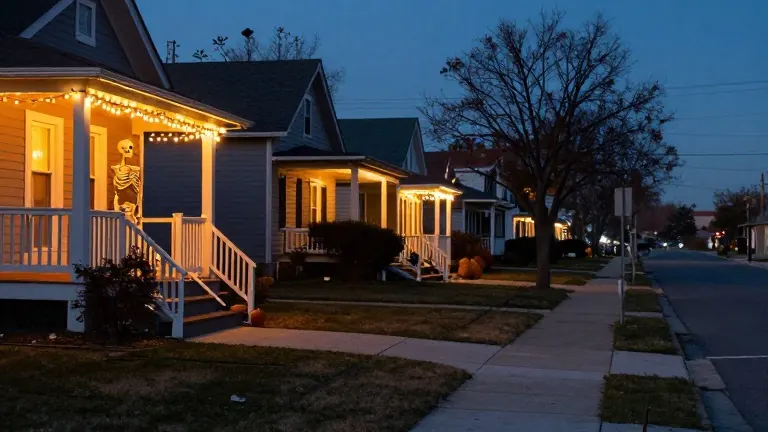
In the United States, the holiday found an open commercial slot between back-to-school season and Christmas. "Candy makers, retailers and pop-up chains built an entire ecosystem around it," Pauwels said. In the 1930s and 1950s, towns organized trick-or-treating to reduce vandalism. Postwar suburbs with walkable streets and front porches turned the activity into a neighborhood ritual. The holiday’s popularity in Britain has grown since the 1980s, driven by American films and television, though locals have not fully adopted the scale of lawn decorations common in the U.S.
Source: Northeastern Global News
More Business · Scam Watch · Report a business · Got a Story?