One of Three Known Nanotyrannus Skeletons Hits Auction Floor for $6 Million
Sotheby's will sell the 10-foot skeleton, nicknamed Jodi, in New York on Tuesday, sparking debate over private fossil ownership.
By Fatima Popov ·
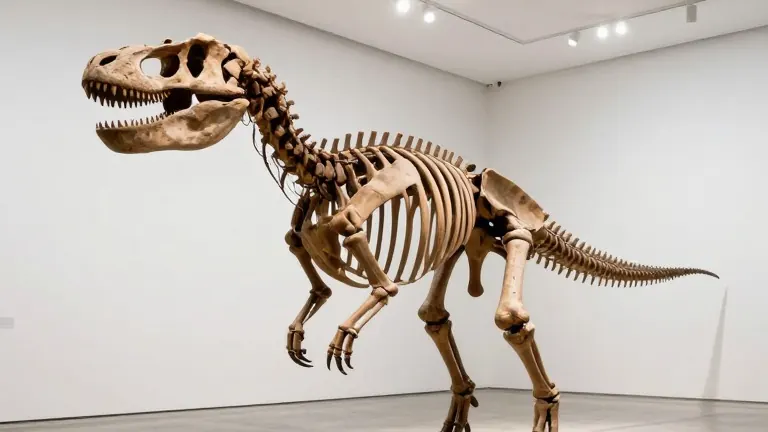
A mounted skeleton of a Nanotyrannus, one of only three such specimens known to science, is set to go under the hammer in New York on Tuesday. Sotheby's has listed the 10-foot-tall fossil with an opening price of $6 million, with estimates suggesting it could fetch up to $9 million. The sale marks the first time a specimen from this distinct genus has come to market since researchers confirmed its classification last October.
The dinosaur, nicknamed Jodi, was long mistaken for a juvenile Tyrannosaurus rex. Megan Jenkins, a palaeontologist at the University of Portsmouth, explained that the animal is significantly smaller and more slender than its larger relative. She noted that Jodi possesses blade-like teeth designed for slicing through meat. The specimen was discovered in Montana by rancher Jodi Pierson and excavated by commercial palaeontologist Clayton Phipps.
Jodi was initially displayed as a young T. rex at the Frieze Masters art fair in London in October 2023. It was not until last October that US researchers Lindsay Zanno and James Napoli published a paper confirming that Nanotyrannus is a separate genus. Their work relied heavily on the Dueling Dinosaurs fossil, which Phipps found eight miles from Jodi in 2006. That specimen, showing a Nanotyrannus and a Triceratops in apparent combat, provided the physical evidence needed to end decades of debate.
The auction follows a record-breaking sale by Sotheby's in July, where a T. rex dubbed Gus sold for $50.1 million. That transaction intensified arguments within the scientific community regarding the private sale of major fossils. Some researchers argue that such specimens should remain in public museums to ensure they are accessible for study and education, rather than locked away in private collections.
Steve Brusatte, a palaeontologist at the University of Edinburgh, called the prospect of Jodi disappearing into a private vault harrowing. He compared the situation to a famous painting owned by a wealthy individual who keeps it hidden from the public. Brusatte suggested that high auction prices could adversely affect scientific research and public access to history.
Jenkins offered a counterpoint, noting that excavation is a costly and labor-intensive process. She stated that she does not begrudge those involved in the dig for seeking a high return on their investment. She added that many fossils sold at auction eventually find their way into public museums, suggesting that Jodi will likely be displayed for the public in the future.
Sotheby's describes Jodi as an excellent exhibition-ready skeleton, noting it contains about 191 fossil-bone elements and a virtually complete skull. The auction is scheduled for Tuesday in New York.
Source: BBC News