National Symphony Orchestra Cuts Season by Half After Leaving Kennedy Center
The 95-year-old ensemble is touring the D.C. region with a reduced budget and no permanent home following the federal building's September closure.
By Daniel Rogers ·
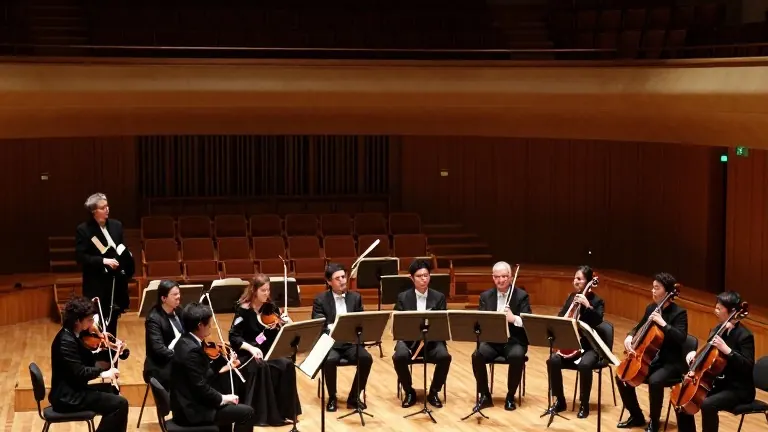
The 95-year-old National Symphony Orchestra has lost its permanent home. Since the John F. Kennedy Center for the Performing Arts closed its doors on Sept. 15, the ensemble has operated as a traveling group across the greater Washington, D.C. region. The closure followed a period of falling ticket sales, public boycotts, and a federal court fight over placing President Trump's name on the building's facade. Trump assumed control of the center in early 2025 after removing several board members and president Deborah Rutter.
Music director Gianandrea Noseda, who has led the NSO for nine years, described the sudden displacement as a shock. He said the news hit like a cold shower and forced him to immediately ask what the orchestra would do without its home. The ensemble quickly secured six alternative venues for its upcoming season. However, the group is operating with a significantly reduced budget while the Kennedy Center's renovation plans remain in flux.
Anne Midgette, a former classical music critic for The Washington Post, expressed deep concern that the orchestra might not survive the transition. She noted that the NSO is deeply intertwined with the Kennedy Center's identity. Because the orchestra had to wait for budget approval from the trustees, it announced its season in mid-August. This delay meant the opening concert took place only 11 days after the Kennedy Center locked its doors.
On Sept. 26, Noseda and the musicians performed at the Music Center at Strathmore in Bethesda, Md. The program featured new works by Carlos Simon alongside pieces by Tchaikovsky and Respighi. Midgette called the evening bittersweet, noting the irony of a major city orchestra performing outside its traditional hall. Critics observe that the orchestra sounds better than ever, yet faces a severe financial blow.
The season is roughly half the length of a typical year. Midgette described the situation as a triumph that the group managed to stage a season at all, but also a major economic setback. The reduced schedule forces the orchestra to question its identity and its relationship with the public. It is an acid test for how invested the audience remains.
Rick Barber, the associate principal double bassist, joined the NSO in 1995. He said the musicians were stunned by the closure and spent the following months in a state of anxiety. Despite the uncertainty, Barber remains focused on the music itself. He noted that political divisions fade when he is playing, and he does not believe the orchestra will fold.
Noseda has chosen to stay and lead the group through the uncertainty. Rather than seeking a new post after the firing of Rutter, he extended his contract with the NSO until 2031. He said leaving would have been too easy and perhaps cowardly for a leader. His strategy involves reaching out to new audiences in different physical locations to maintain the ensemble's presence.
Financial challenges are mounting. The Washington Post reported in August that ticket revenue is expected to drop by about half. Donations are projected to fall by a quarter, partly due to cuts in the Kennedy Center's development department. The orchestra has also lost key staff, including former executive director Jean Davidson, who left in March citing the turmoil at the center.
The NSO's struggles reflect a wider trend among American symphonies. Many groups are facing financial pressure, and some, like the Phoenix Symphony, have recently shut down. Midgette pointed to the basic cost of living, such as gas and groceries, as a barrier for audiences trying to attend live performances. The NSO is now testing whether enough Americans care about symphonic music to sustain the institution.
The opening night concert in Bethesda ended with a packed house cheering for the orchestra. Noseda believes in the power of music to bring people together even during difficult times. It remains unclear how long the NSO will be without the Kennedy Center. The group is currently performing a shorter season in various halls while waiting for the future of its permanent home to become clear.
Source: WEVO