A Century of Crashes, Cats, and Cold War Tests
The period from late October to early November 2026 marks anniversaries of Black Tuesday, the hydrogen bomb test, and Laika's orbital flight.
By Fatima Popov ·
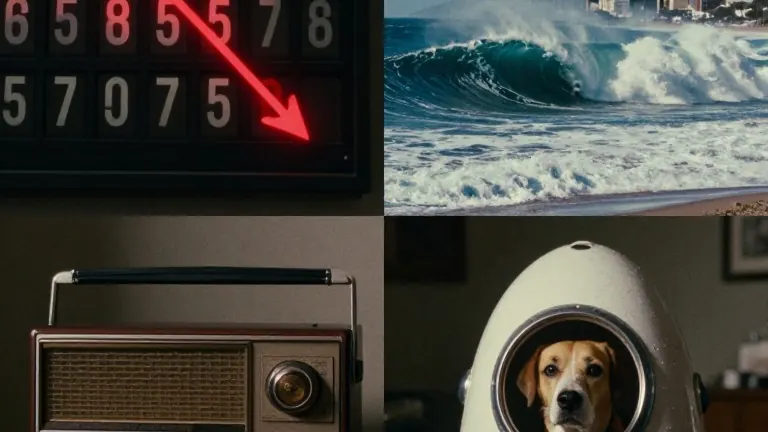
The calendar turns a corner from late October into early November, bringing a cluster of historical milestones that span nearly 300 years.
On October 29, the New York Stock Exchange experienced the crash known as Black Tuesday in 1929. That event precipitated the Great Depression. Eighty-four years later, on the same date in 2012, Hurricane Sandy struck the region.
The following days offer a mix of cultural and political history. On October 30, 1938, a radio broadcast of The War of the Worlds starring Orson Welles caused nationwide panic. Also on that day in 1974, Muhammad Ali knocked out George Foreman in the eighth round of a 15 round bout in Kinshasa, Zaire. The fight is known as the Rumble in the Jungle.
Construction on the Mount Rushmore memorial was completed on October 31, 1941. In 1992, Pope John Paul II admitted that the Roman Catholic Church erred in convicting Galileo of heresy 350 years earlier. On November 1, 1765, the Stamp Act went into effect as the first direct tax on the American colonies. That same year in 1952, the United States exploded the first hydrogen bomb in a test in the Marshall Islands.
On November 2, 1889, North Dakota and South Dakota became the 39th and 40th states. In 1959, Charles Van Doren admitted he had been given questions and answers in advance for the game show Twenty One. On November 3, 1952, Clarence Birdseye marketed the first frozen peas. In 1957, the Soviet Union sent the dog Laika into space aboard Sputnik II. Laika died in orbit.
The timeline concludes with two major events on November 4. In 1842, Abraham Lincoln married Mary Todd in Springfield, Illinois. In 2008, Barack Obama defeated Sen. John McCain for the presidential election, taking 338 electoral votes to McCain’s 161.
Source: Rockaway Times