Early Universe Light Rules Out Massive Black Holes as Dark Matter
Analysis of cosmic microwave background data shows that black holes exceeding 100 billion solar masses are not a primary component of the universe's missing mass.
By Fatima Popov ·
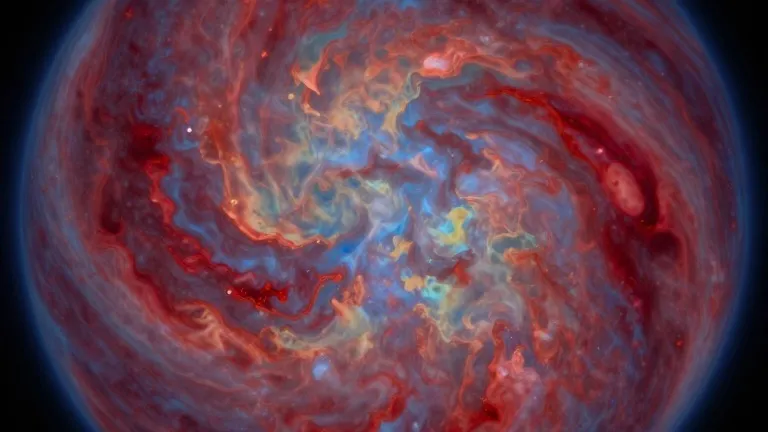
A new study concludes that black holes heavier than entire galaxies do not make up a large portion of dark matter. The research team analyzed light from the early universe to test whether these massive objects could explain the invisible substance that holds galaxies together.
Dark matter is estimated to constitute about five-sixths of all matter in the cosmos. Scientists have long suspected it because galaxies rotate too fast to stay bound by the gravity of visible stars and gas alone. While the exact nature of this material remains unknown, black holes have been considered a possible candidate due to their immense mass and difficulty in direct observation.
The researchers specifically examined what they term stupendously large black holes, which have more than 100 billion times the mass of the sun. Objects in this category would outweigh whole galaxies. Although the largest known black hole is approximately 36 billion solar masses, no such gigantic objects have been detected in galaxy surveys. The team wanted to determine if these unseen giants could still represent a substantial fraction of the total dark matter.
To investigate, the team studied the cosmic microwave background. This radiation is light released about 380,000 years after the Big Bang when the universe cooled enough for atoms to form. Christopher Gerlach, a theoretical physicist at the Mainz Institute for Theoretical Physics in Germany, described this light as a snapshot of the infant universe. He noted that if dark matter were concentrated in a few gigantic objects, the universe would appear grainy on very large scales.
Antonio Iovino, a co-author and theoretical physicist at New York University Abu Dhabi, pointed out that the background's temperature varies from place to place by about one part in 100,000. These minute variations reveal how matter was distributed in the early cosmos. The analysis showed that the background lacks the specific graininess that stupendously large black holes would have created if they were a major component of the universe's mass.
Nicholas Leister, another theoretical physicist at the Mainz Institute, stated that the data confirms these black holes cannot be a significant part of dark matter. The authors clarified that this does not mean such objects cannot exist, only that they are not a primary constituent. They added that smaller black holes, roughly the size of asteroids, might still be possible candidates and are currently under review. The findings will be published in Physical Review Letters on Oct. 26.
Source: Space.com